I'm Gabriela. As DeepL's first Product Manager, I took its apps from zero to both app stores, then turned deepl.com into a front door for business customers. Today I build with AI: my latest product, PASSOATE, launched in November 2026.
Open to work · Hybrid in NRW · Remote across Europe
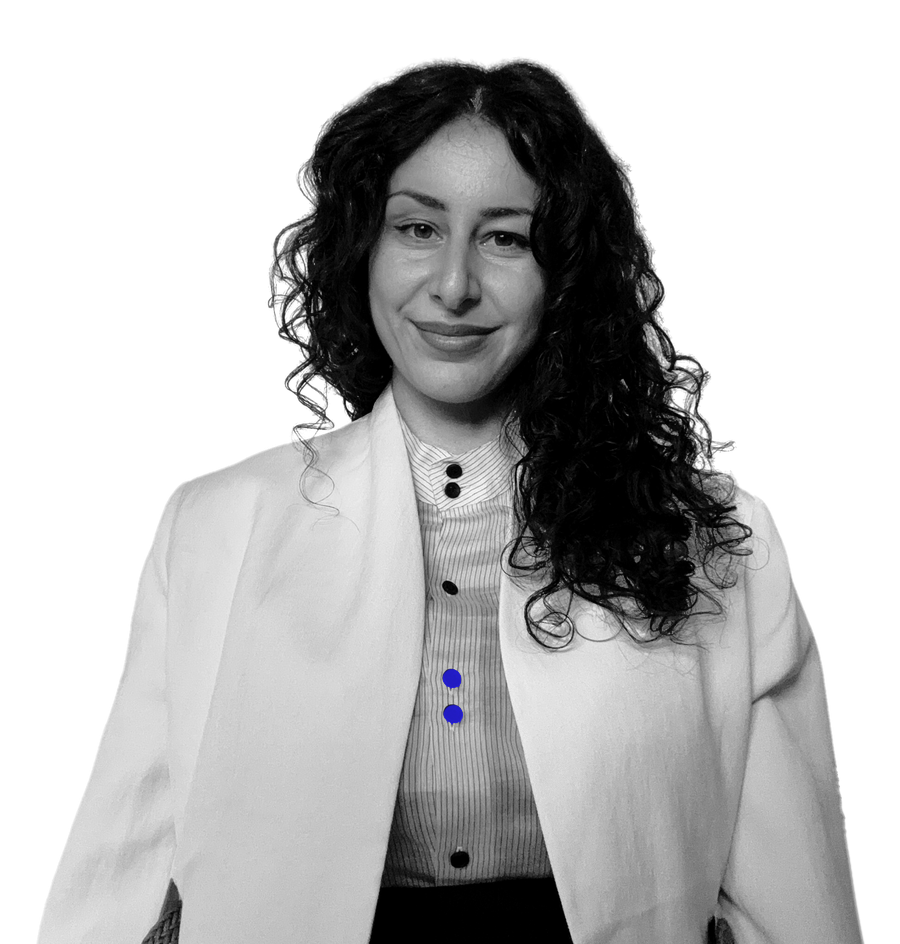
Every company has gaps. I happen to like them.
“Gabriela is a PM who actually digs into eventIDs, writes the SQL, and reads the funnels herself, and she brings the same energy to the design side. […] And whenever the conversation started drifting toward optimizing for the wrong thing, […] she'd pull us back to the simple question: what does this do for the person using it?”
“Great drive and ability to get things done. Gabriela was responsible for all DeepL's app launches and much more.”
“What makes Gabi truly special is her ability to operate at every stage of a product's life. She understands the scrappy, ambiguous work of early-stage building just as well as she understands the discipline required to scale.”
Recommendations from my LinkedIn profile. Read them in full ↗
If I can't name the person it helps, AI won't fix that. The user's problem comes first here too.
I use AI so a team can answer its own questions and act autonomously, without waiting in someone's queue. Speed is a nice side effect.
AI prepares the decision. A person makes it. The final call is a judgment call, and that stays with us.
Languages have followed me everywhere. Aramaic and German at home, English at work, Italian by choice. Maybe that’s why a translation company felt like home for seven years.
I learn by doing, at work and off it. When I travel, I skip the itinerary and find the place by walking it. At home, I test new recipes on the people I love.

A Staff or Principal product role at a company where something important is still missing.
I bring a builder's range: strategy, specs, UX, QA, SQL and, these days, code written with AI. I've led teams as Group Product Manager and chose to return to hands-on work, because that's where I'm at my best. Give me trust, autonomy, and smart, humble people to build with, on a product that sparks joy.
LinkedIn is the quickest way to reach me. I answer. Promise.
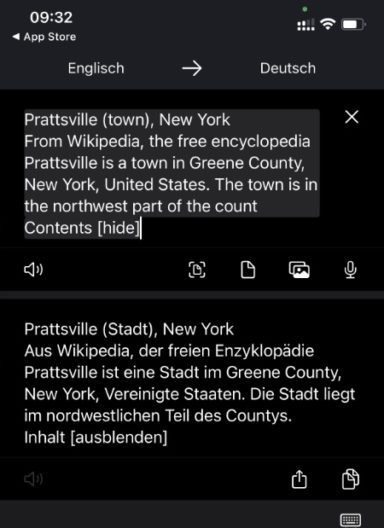
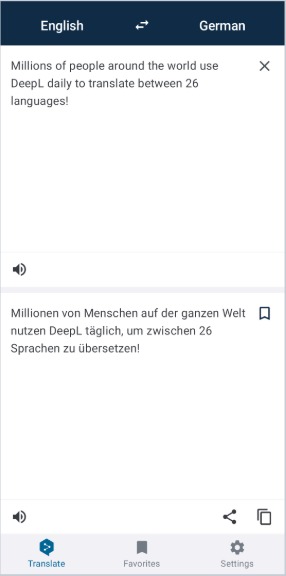
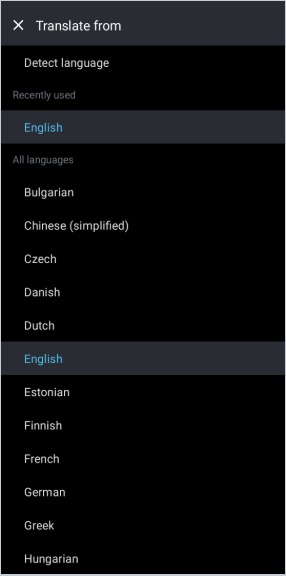
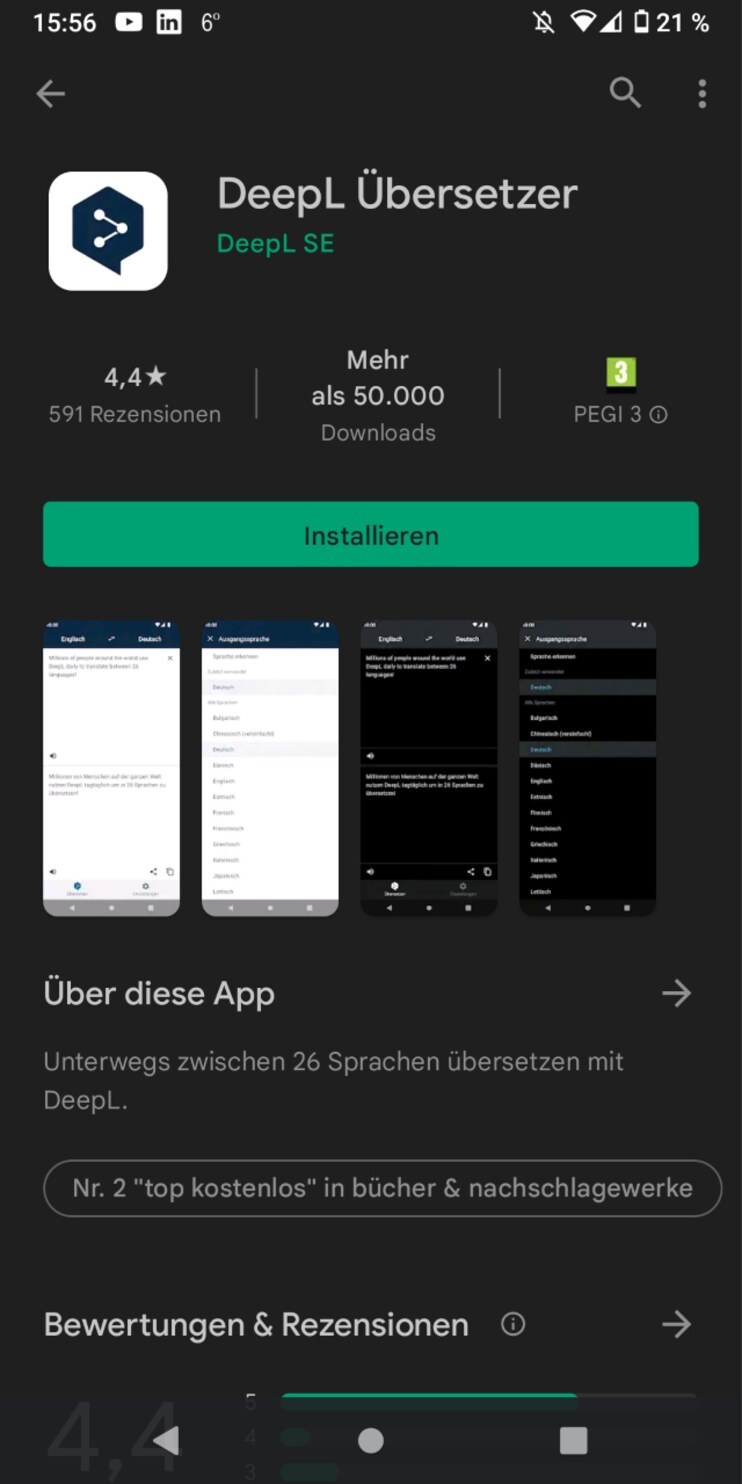
Every day, thousands of people searched for a DeepL app that didn't exist. This is how I made the case for it, kept the first version small, and what happened when it reached the stores.
When I joined in September 2019, DeepL had put desktop first. The Mac and Windows apps were live as first versions, and most of the product was built around larger screens.
On a phone, the translator was available in the mobile browser. There was no app.
The established translators, like Google Translate and Microsoft Translator, were one tap away on the home screen. And with my experience working on native apps at CHECK24, I knew what an app icon can do for usage. DeepL was known for the quality of its translations, but on a phone it took more steps to reach.
My hypothesis: people who preferred DeepL at their desk were using another translator on their phone, simply because it was closer.
The idea had to share my desk with everything else on my plate. For my first six months I was DeepL's only Product Manager, responsible for the website product and the desktop apps, whilst hiring the next Product Managers on the side. Even after one of them took over the web translator, my scope stayed wide.
A hypothesis from another industry is not a reason to change a company's priorities. So I went looking for evidence.
Leadership had a fair question: would people translate as much text on a phone as at their desk? I didn't expect them to. I figured shorter texts were the likely answer, so the real case had to be different: an app would bring people back more often, and it would reach people who had never used DeepL.
I built the case from this evidence and added a very rough mock-up of a first iOS version to show how little it would take to find out. Leadership approved the work. A few months later the app was in the App Store.
Nobody set me a target or a date. I gave leadership my own estimate for first-month downloads, and a timeline I had agreed with the engineers before the pitch.
The point of the first version was to prove demand. For that, the app had to do one job well: translate whilst on the go.
The harder question. The desktop product was far ahead of what we were about to ship. Was a basic app good enough? My argument: a basic app that works well is better than no app. Every time someone picks another translator on their phone, there is a risk they stay with it, on the desktop too.
We started with one developer, a designer and my sketch. DeepL had no marketing department yet, so everything around the app was part of the product work too.
A quiet launch. The iOS app went live in May 2021 with no campaign and no marketing budget. The Android app followed in February 2022.
The first version beat the estimate I had given leadership. Then the tracking answered the questions the pitch had left open.
With demand proven, the next features were chosen to make the app more than a smaller version of the desktop product.
I stayed responsible for the apps until April 2024, first as the hands-on product manager and later as Group Product Manager. At its peak the team had grown from one developer to two designers, QA, and one engineering manager and about two developers per platform. Usage and revenue numbers stay with DeepL.


One thing: I would make the case earlier.
What stayed with me is how to build a business case: which facts move a leadership team, and that a gut feeling becomes a decision once it is backed with data. I have worked that way ever since.
“Great drive and ability to get things done. Gabriela was responsible for all DeepL's app launches and much more.”
LinkedIn is the quickest way to reach me. I answer. Promise.
DeepL already had many business customers. The website didn't tell that story yet. This is how we changed that.
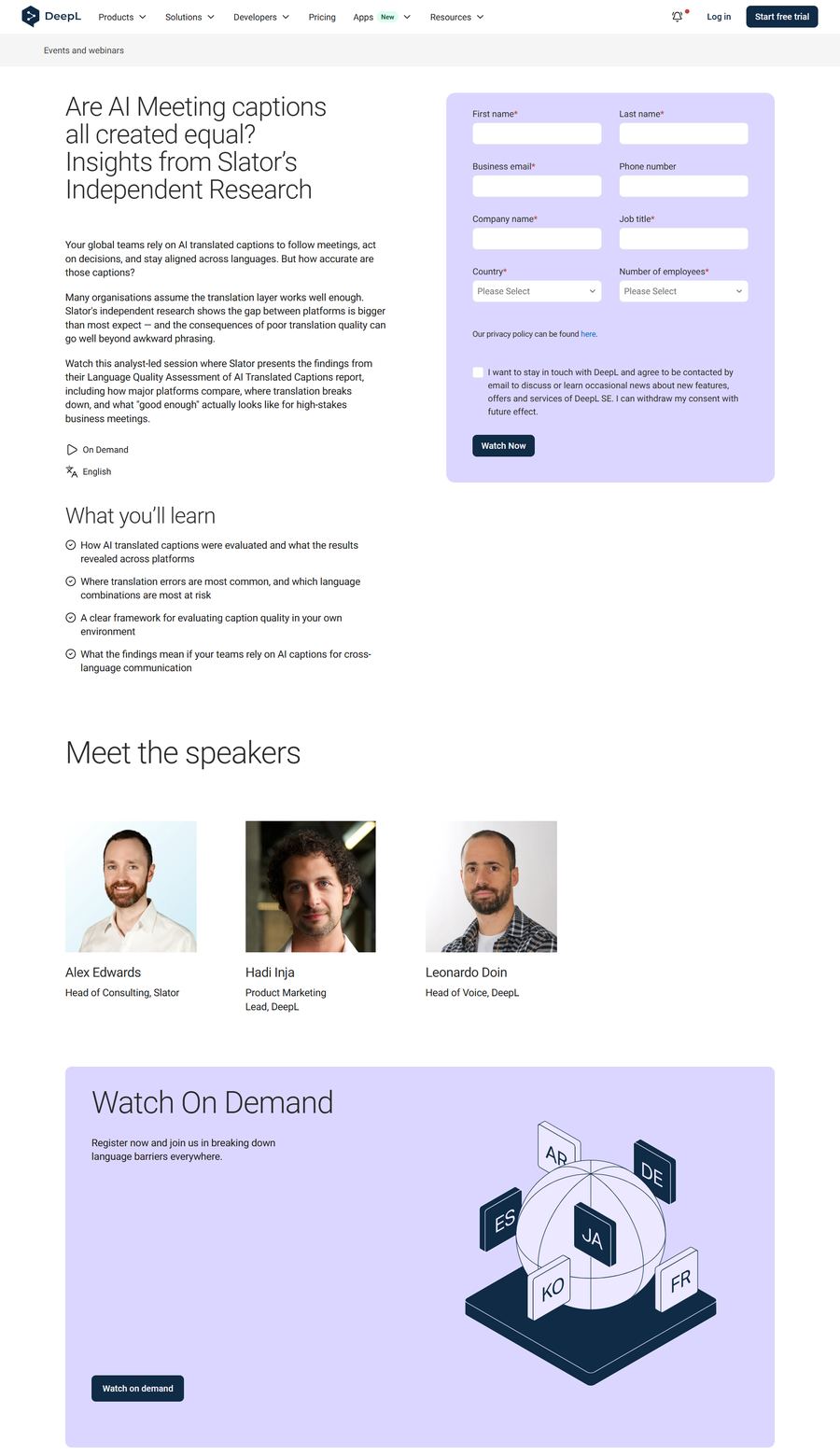
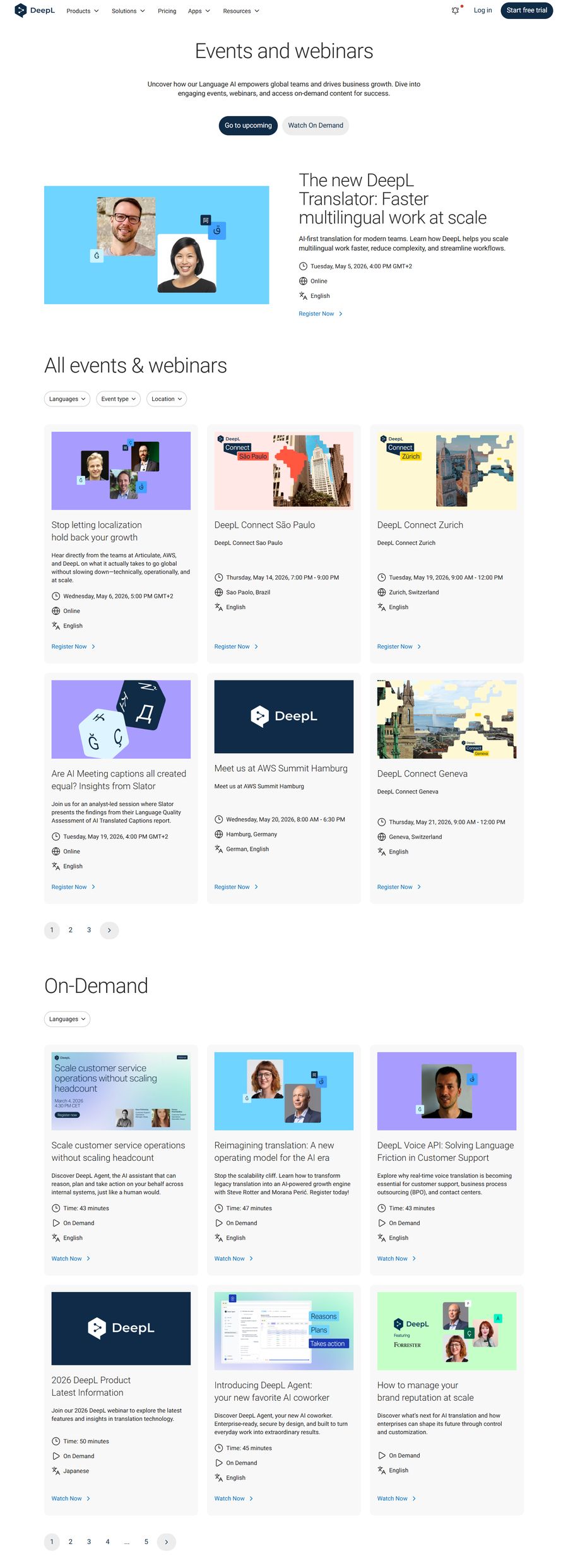
In spring 2024, deepl.com opened straight on the translator. The navigation was minimal, and only one page spoke to businesses.
Someone evaluating DeepL for their company arrived with questions the site didn't answer yet. Which teams is this for? Which use cases and industries? How does DeepL handle security and quality?
I had spent almost five years on the product itself. Selling it through the website was new ground for me. I took it on anyway, formed a new team, and we defined its mission, vision and goals, the Why at its core, before we built anything.
Shipping one page at a time would not change how people saw DeepL. I decided to ship a whole content experience at once: 25 pages and a new navigation, in six weeks.
The audience was already wide: different teams, industries and use cases. One new page under a Solutions menu wouldn't have done the job. So the plan was breadth first, and I set the number and the deadline as non-negotiable. One of my mottos is Parkinson's law: work expands to fill the time you give it. And I gave it six weeks.
The commitment bought something in return. Because I promised the date, leadership agreed that my team would work on nothing else in parallel.
There was one trade-off though. Building content SEO into every page would have taken more time. We agreed to go for speed first, so this step was optimised for conversion. Search work came later.
What I chose not to do at that stage was redesigning the landing experience. It was shared across several teams, so we started where we could move autonomously: the navigation.
The riskiest assumption was quite basic, that this kind of content would raise business conversions at all. So we planned to test it instead of assuming it.
Nothing like this had been done at DeepL before, and the AI tools of 2024 were far more basic than today's. The speed had to come from how we worked.
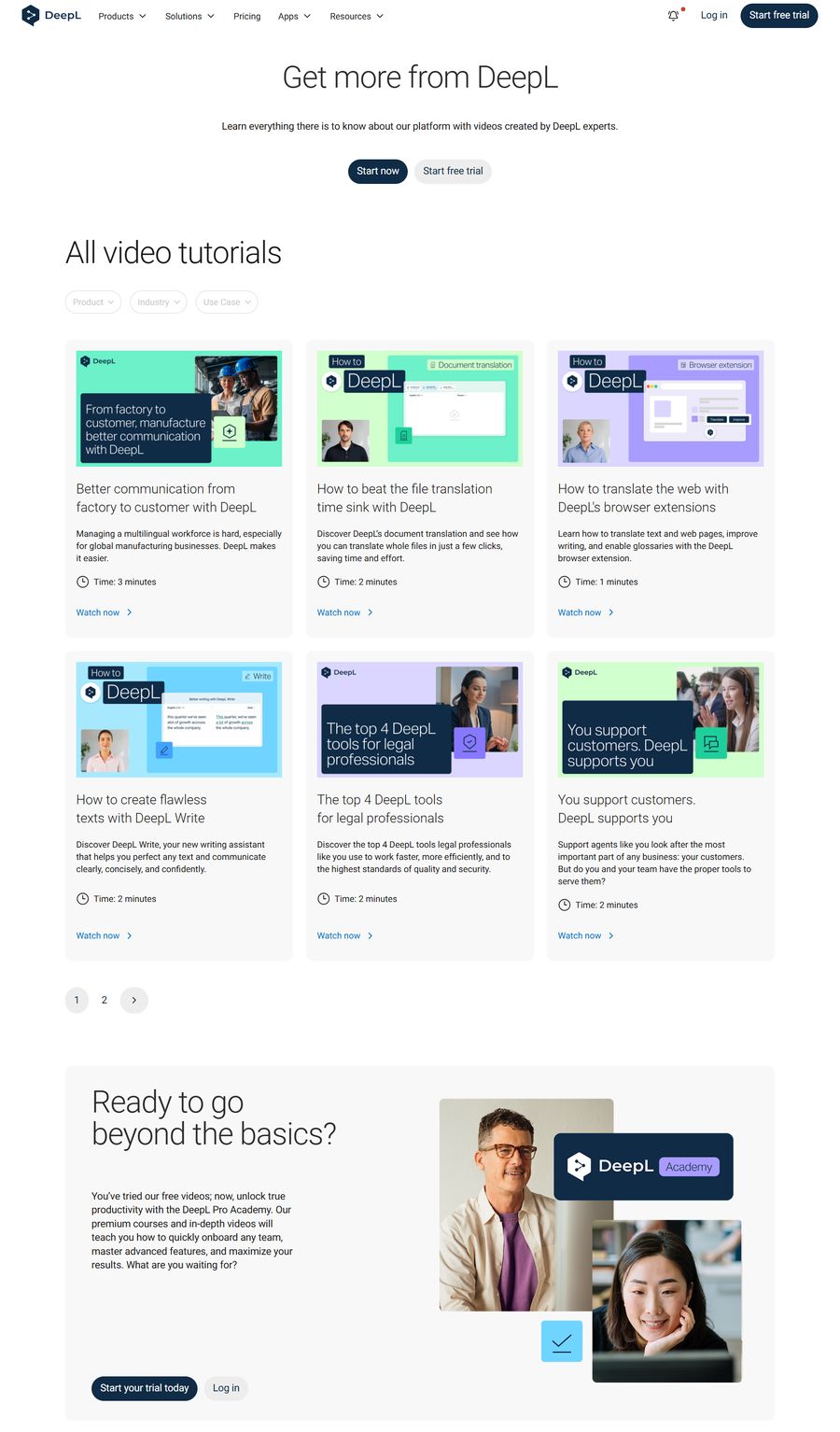
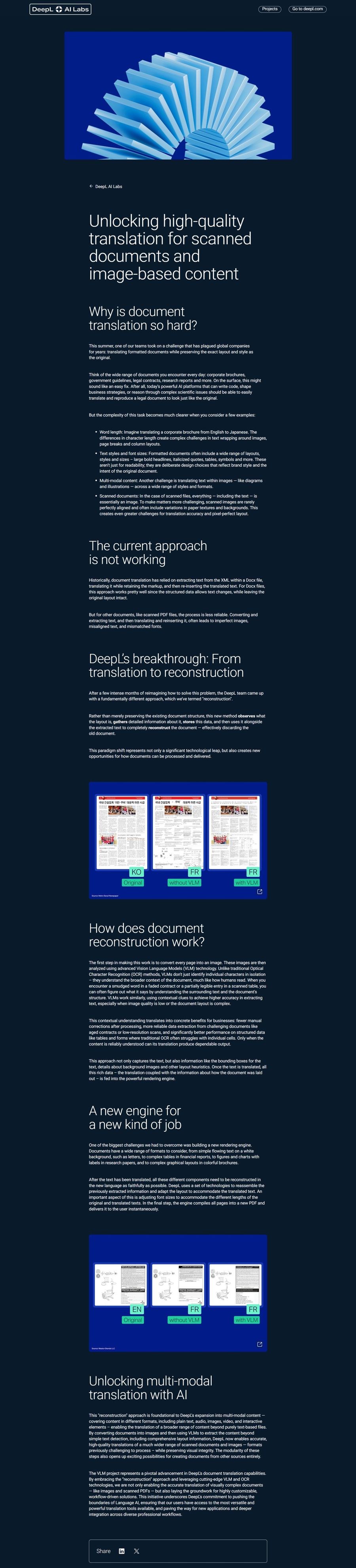
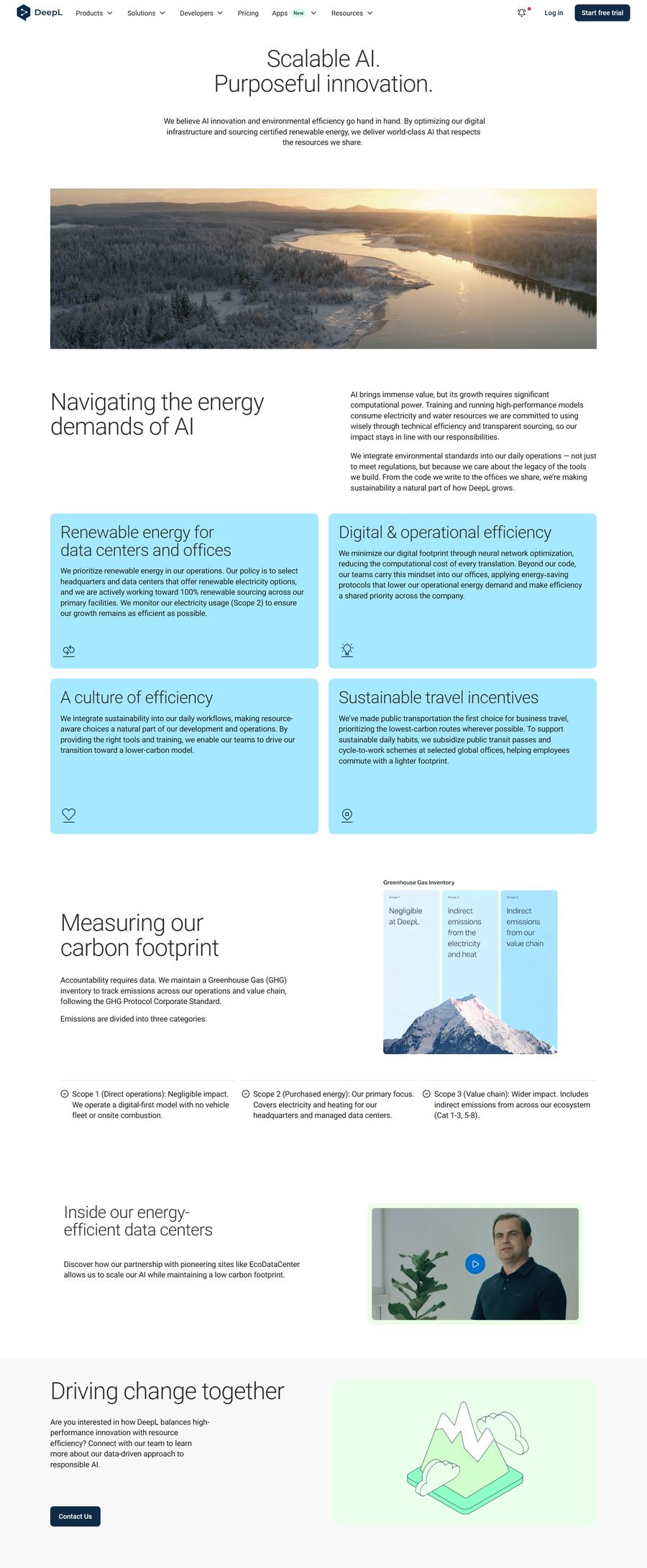
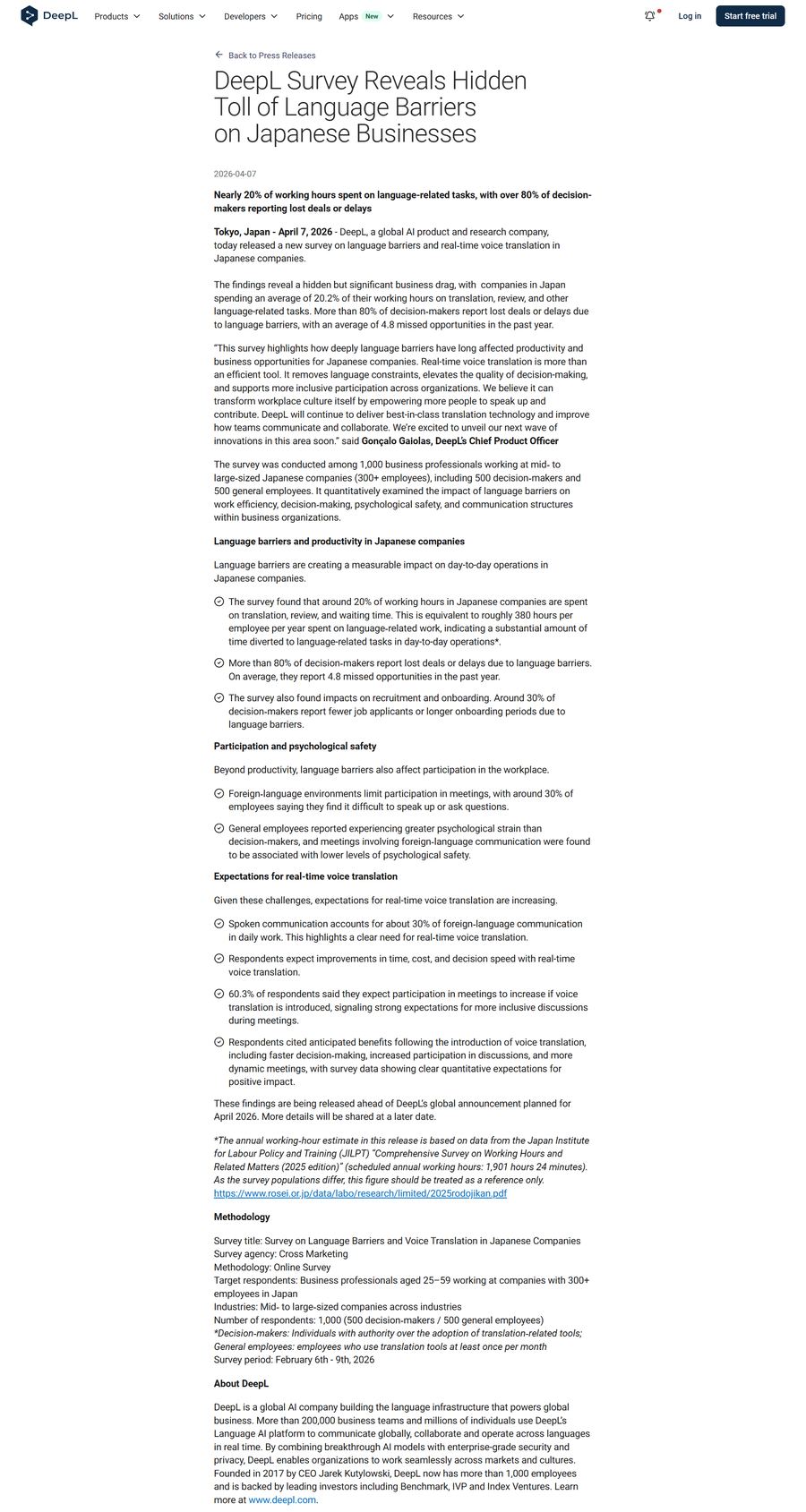
What the launch showed. The experiment was clear. With the new navigation and pages, self-serve conversions and sales enquiries both went up. The 25 pages were later shown at the company all hands as a best-practice example.


Before
After
Before
After
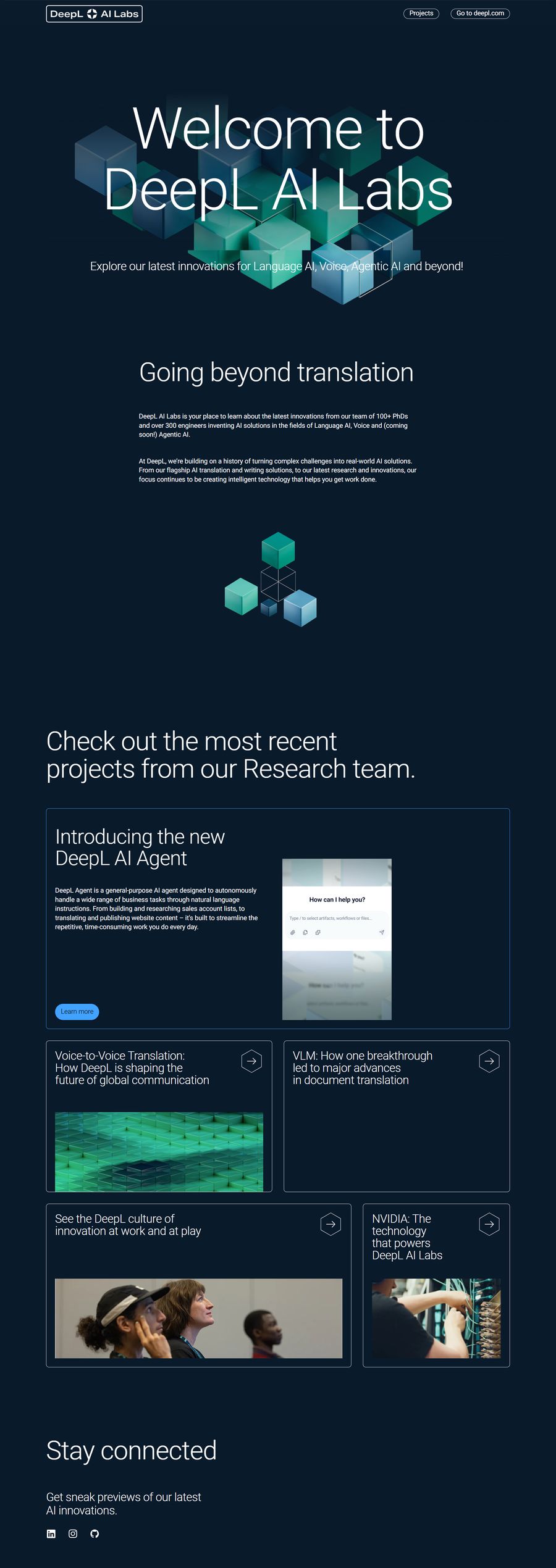
AfterAnyone who typed deepl.com was sent straight to the translator. It filled the first screen, and that first screen shaped what people thought DeepL was.
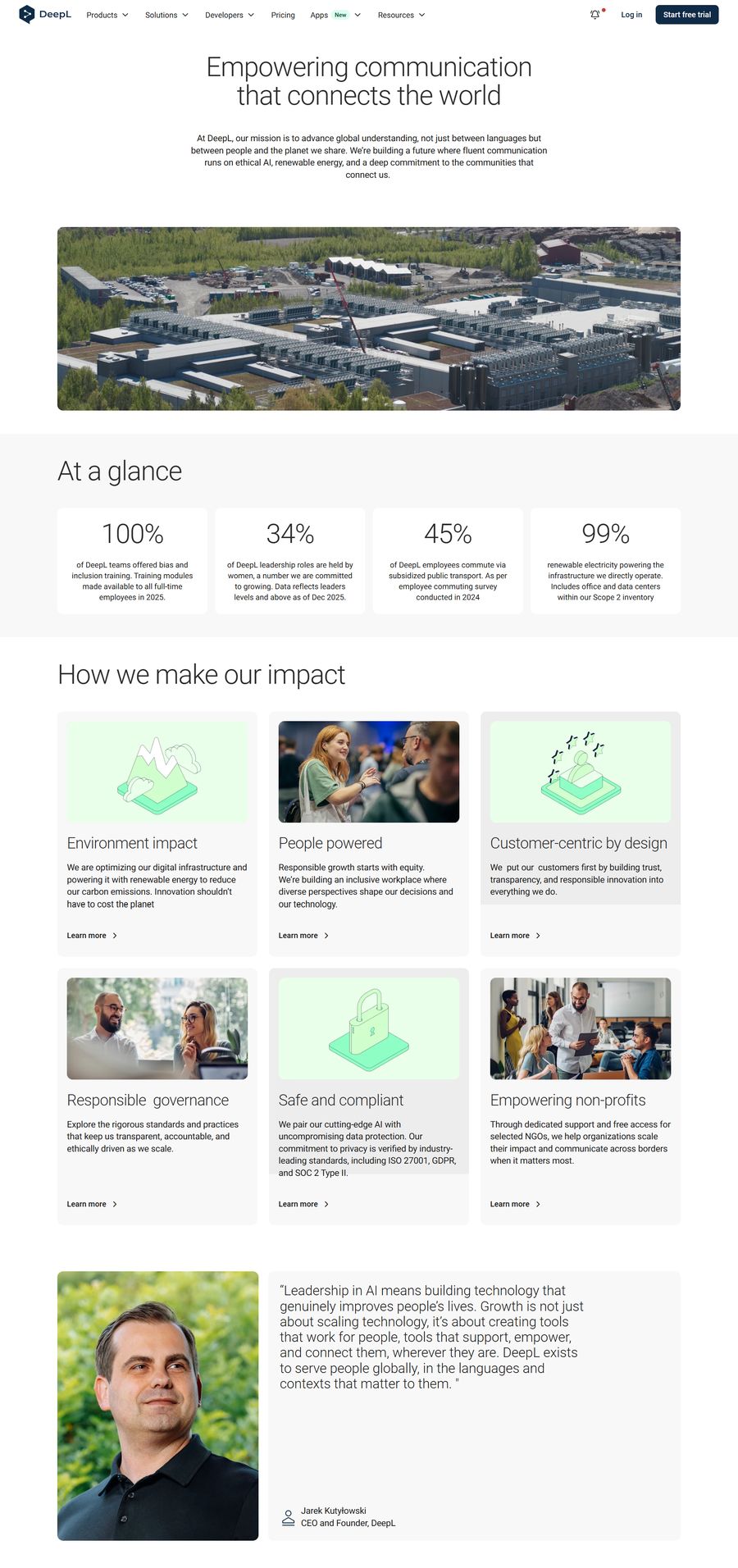
Newer products such as DeepL Voice could be found in the Products menu and the footer. Few visitors look there. I wanted the first screen to show the whole product suite, so that someone arriving could see at a glance what DeepL offers, and whether it was for them or not.
Before
After


Each hub and the pages inside it run on templates I defined. The templates follow UX best practice and are built to convert. Marketing publishes without engineering and without reimagining a page each time, so every craft contributes what it does best.
Along the way we built nearly 100 landing pages in total, and templates for blog posts, webinars and customer stories. My team also owned the site's navigation and footer. As Staff Product Manager I also led SEO, with a Senior Product Manager for SEO reporting to me.
One thing we learned along the way: building for search from the start is far easier than adding it later.
Three things, and none of them is about the pages.
“What makes Gabi truly special is her ability to operate at every stage of a product's life. She understands the scrappy, ambiguous work of early-stage building just as well as she understands the discipline required to scale.”
LinkedIn is the quickest way to reach me. I answer. Promise.
We collected plenty of usage data. Getting an answer out of it could take weeks. This is how I built a workflow in a few hours that gave my team its answers, and its monthly report, without waiting for anyone.
We collected a lot of usage data. To get an answer out of it, you wrote SQL and built the chart yourself in a separate visualisation tool.
At CHECK24 I had only ever consumed data. So at DeepL I learned SQL: a course, a lot of practice, and reverse-engineering the queries of colleagues who were far better at it than I was. Later an AI chatbot helped me write the harder ones. I still had to run each query, build the chart, save the dashboard and send it round.
Some questions went beyond what I could do myself. Those went to the data analysts and scientists, who served many teams. Depending on priorities, an answer could take several weeks.
The data was there, but until the answer came we couldn't act on it. On the website that meant pages we could not improve in time, or not in the data-driven way I would have preferred.
When it became possible to connect an AI assistant to our data, I stopped asking for capacity and built the answer machine myself.
It was a tool for me and my team, so I didn't make it a project. I spent a few hours on a first version, showed it, and improved it with the feedback that came back.
I wanted three things from it: the quantitative insights we needed to make data-driven decisions and guide our strategic investments, a team that no longer depended on someone else's capacity to get them, and less manual work for me. One rule came with it. The workflow reports; it does not dictate how we react. People still make the decisions.
A question in plain language goes in. An answer, a dashboard and a short message to the team come out.
Monthly report: TL;DR
Simplified illustration with example data.
The dependency was gone. And the team started to use the data, because it now came to them.
I would say out loud that I was working on a solution, and ask who wanted to join.
While I was building this, another team outside the data organisation was building something similar. Neither of us knew.
Today I'd share up front that I have an idea for solving it, and ask whether other teams or peers with the same problem want to team up. People with the same problem would be aligned from the start, could divide the work, and nothing would be built twice.
“Gabriela is a PM who actually digs into eventIDs, writes the SQL, and reads the funnels herself, and she brings the same energy to the design side. […] And whenever the conversation started drifting toward optimizing for the wrong thing, she'd pull us back to the simple question: what does this do for the person using it?”
LinkedIn is the quickest way to reach me. I answer. Promise.
PASSOATE is a calm daily Italian course for adult beginners. I designed and built it end to end with AI, and I use it every day alongside my class. This is how I built an app that never interrupts the learning, the calls I made, and what is still unproven.
I love Italy and its language, but I failed several times at learning it properly.
For years I had an on-off relationship with the big language apps. I had streaks of over 100 days and still didn't feel I was progressing. At first, the app I used taught sentences nobody needs in real life and explained no grammar at all. Later, the gamification that had kept me consistent started to outweigh the learning. Even with time set aside, I kept getting pulled away from Italian: rewards to collect, things to unlock, an avatar to dress up. And not one app explained something as basic as which article goes with which word and why.
At the end of 2025 I decided to take Italian seriously and signed up for a weekly in-person class for beginners. It started in February 2026 and became one of my weekly highlights. Between classes, though, I mostly didn't practise. During a course break I went back to one of the apps, and found it more annoying than helpful. So I stopped, and thought: why not build something myself?
In June I built a very simple app for myself, based on my course book, in under an hour. After I posted about it, a few people asked to use it, but the course-book content wasn't mine to share. So in October I built a public version with original content that takes you through A1, for people who want the learning without the game, like me.
No gamification for the sake of retention and engagement.
Two questions shaped the product:
Every call traded something away. These are the ones that shaped the product.
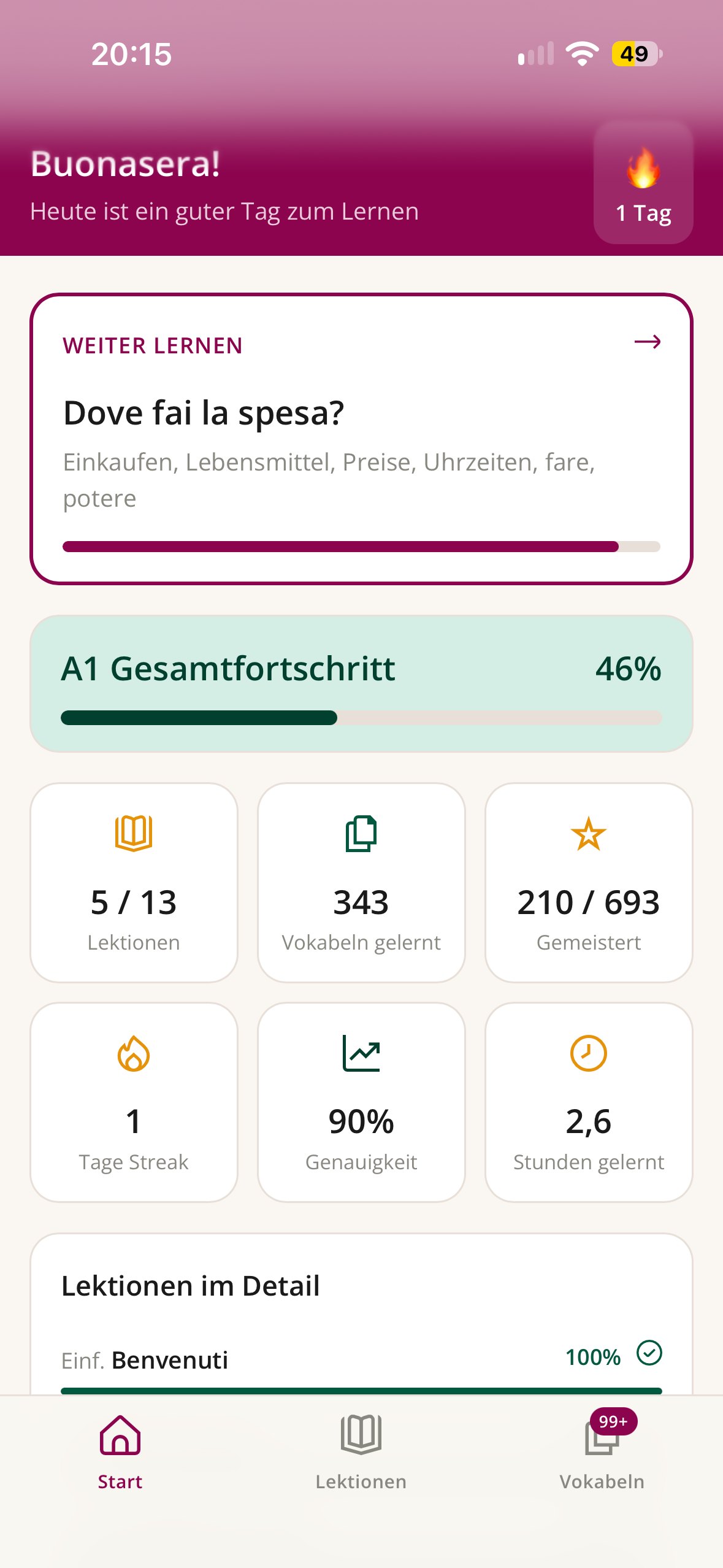
My first version looked like every other learning app: six counters competing for attention. It measured a lot and helped little.

I didn't remove progress. I made it honest.
The rebuild, including a complete redesign, took about a week. I owned the direction and every decision. Claude did the build.
AI produces a lot of output very quickly. That doesn't make it correct, consistent or useful. My job was to make sure it was all three.
Launch: PASSOATE went live on its own address, passoate.com, in November 2026.
Did I come back? Yes. I practise for about 20 minutes on every day I don't have class.
Am I learning? I am halfway through A1. Still doing my course and practice every day with my app.
How long does A1 take? Instead of guessing, I had Claude run simulated learners through the real app code. These are model estimates, not measurements. At 15 to 20 minutes a day, a learner reaches the A1 test in roughly four to ten months, depending on how much they remember. More time helps less than expected: words have to come back over days and weeks, and that spacing can't be rushed.
I'm moving faster than the model. My weekly class covers the same ground, and I pick up vocabulary quickly. That's one more reason my own numbers can't stand in for other learners.
The bet held for its first user. But that user built the app, cares about the outcome and has a weekly class to keep her going. I'm not a representative sample.
Validated: I come back daily, I can see myself improving, and a native speaker has checked the content.
Not validated yet: whether other learners stay consistent when nothing in the app tries to keep them there longer.
Friends and a few classmates from my course now use PASSOATE. After four weeks I'll ask them three things:
My own measure is the A1 final test once I reach it, and A2 by early to mid 2027. Their answers decide what comes next. Accounts are possible, but I won't add them before there's a reason to. Anonymous, opt-in usage statistics show me how people use the app.
Build with original content from day one.
My first version was for me alone, built around my course book, so I couldn't share it with the people who asked for it. With original content from the start, I could have put it in their hands in June and learned from real learners months earlier: what works, what doesn't, and who wants to learn without the game.
LinkedIn is the quickest way to reach me. I answer. Promise.

Legal notice
Operator of this website:
Gabriela Buran
c/o Juwelier Barok
Chausseestraße 1 (A10 Center)
15745 Wildau
Germany
Email: email address
Last updated: 9 November 2026
This is a personal portfolio. It has no contact form, no accounts, no cookies, no tracking and no advertising. Some technical data is processed when you visit, because a website can't be delivered without it. This page explains what that is.
Gabriela Buran
Email: email address
This site is hosted by Netlify, Inc., 101 2nd Street, San Francisco, CA 94105, USA. When you open it, Netlify processes the data your browser sends with every request: your IP address, the date and time, the page requested, the referring page, and your browser and operating system. This is needed to deliver the site and keep it secure. The legal basis is Art. 6(1)(f) GDPR. My legitimate interest is a site that works and is protected against misuse. Netlify is certified under the EU-U.S. Data Privacy Framework and also uses the EU standard contractual clauses for transfers to the USA. More in Netlify's privacy statement ↗.
The fonts are hosted together with this site. Your browser doesn't connect to any font service.
This site links to LinkedIn and to PASSOATE. Nothing is sent to these services until you click a link. Once you're on their pages, their own privacy policies apply.
I use your email address and what you write only to reply to you. The legal basis is Art. 6(1)(b) GDPR when your message is about a possible collaboration, and Art. 6(1)(f) GDPR otherwise. I delete the conversation when it's no longer needed, unless I'm legally required to keep it.
You have the right to access the data I hold about you, and to have it corrected, deleted or restricted. You can object to processing based on Art. 6(1)(f) GDPR and ask for your data in a portable format (Art. 15 to 21 GDPR). Just email me.
You also have the right to complain to a data protection authority. For me, that's the Landesbeauftragte für Datenschutz und Informationsfreiheit Nordrhein-Westfalen (LDI NRW), Kavalleriestraße 2–4, 40213 Düsseldorf.